Spain’s immigration worsened its fiscal outlook, Stone says
Fernández-Villaverde’s 1995–2026 scenario finds the working-age share barely changed despite immigration, sharpening the debate over public finances in an aging society.
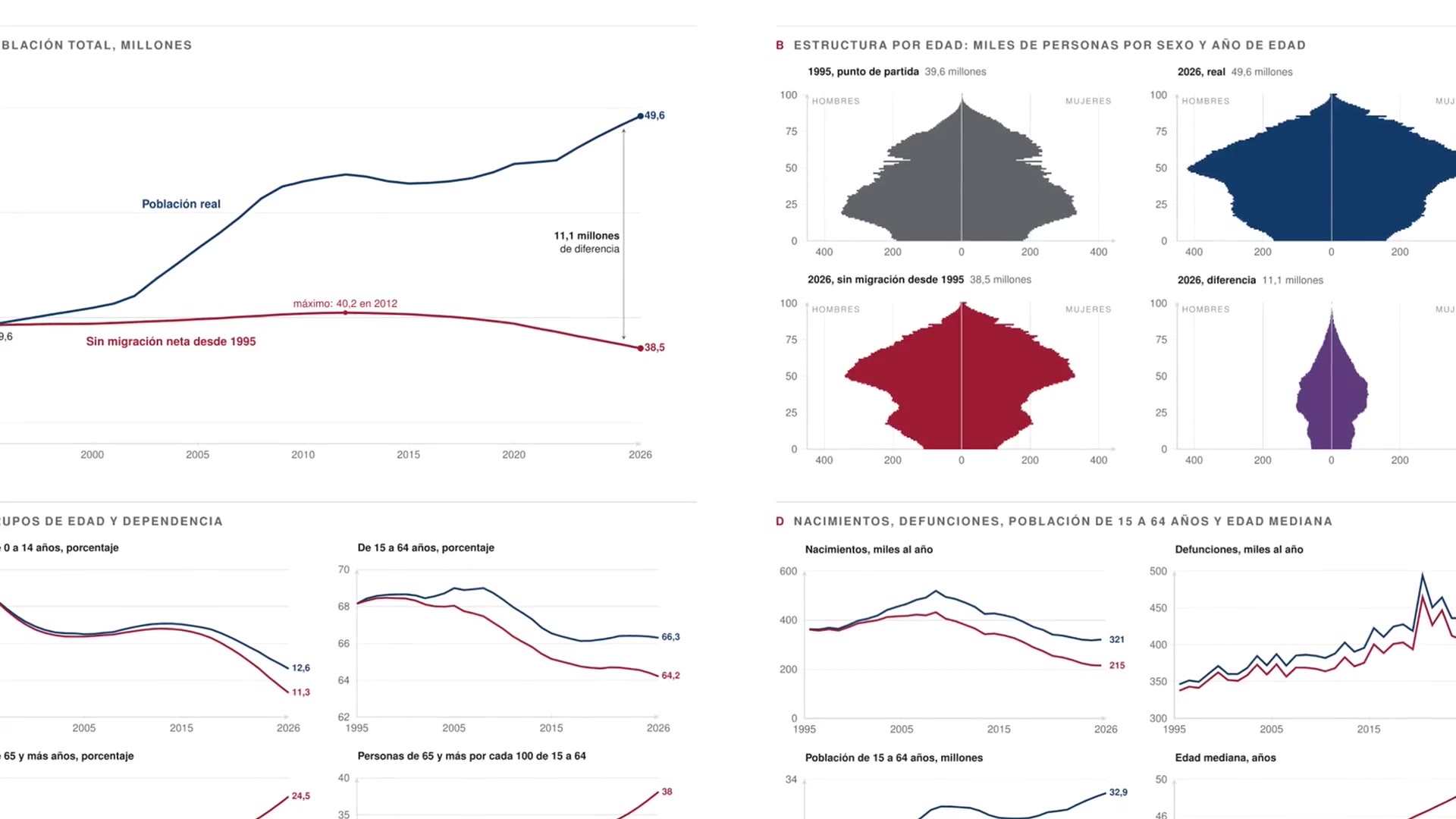
He ties that judgment to a highly redistributive welfare state and to immigration he describes as mostly low-skilled.
That conclusion cuts against the argument that immigration can fix the budget of an aging society. The post displayed 50.3K views1.
His calculation follows.
For a scenario with zero net immigration from 1995 to 2026, Fernández-Villaverde starts with Spain’s 1995 population structure and assumes fertility and mortality by age would be the same as observed.
FEDEA authors José Ignacio Conde-Ruiz, Clara González and Miguel Díaz-Salazar examine a different period and measure: they estimate immigration mitigated about 60% of the deterioration in Spain’s demographic dividend between 2000 and 2019. Their finding concerns the demographic contribution to income growth, rather than the balance between government revenue and spending. They also say demographics will continue weighing negatively on growth even with projected inflows2.
FEDEA's authors calculate that the working-age share would have fallen 0.39% a year in 2000–2019 without immigration, against 0.16% with it2.
Fernández-Villaverde says readers could adjust fertility upward in a lower-immigration scenario because housing prices would almost certainly be lower; he says higher fertility among some immigrant groups would push the other way.
The FEDEA authors hold productivity constant, so they describe their estimates as a lower bound of immigration's total impact. They report that foreign-born residents had a higher employment rate than native-born residents in 2024, 60.4% against 50.1%. They also report that the total fertility rate of women with foreign nationality fell from 1.86 children in 2002 to 1.28 in 20232.
The family-first test is whether public policy helps households build a stable future, not whether it enlarges the population. Policymakers presenting a demographic remedy should explain its fiscal consequences as well. Families deserve that accounting before demographic projections become promises about sustainable public finances.
Sources
FAMILY BRIEF The news and network for the American family.